An ulcer that just won't heal — yours, or a parent's — usually has a reason. Three routes at 13 Church Street can help: a consultant vascular surgeon who finds and treats the cause, a specialist nurse-led wound clinic, and nurse-led dressing care that comes to your home. And because for this condition the NHS route is genuinely the standard of care, this page explains that honestly too.
Consultant vein assessment — UK Vein Care · Specialist wound clinic — Gentell · Dressings & home visits — Aespect · The NHS route, explained honestly · or call 0345 11 22 300
A treatment room at 13 Church Street. Every photo on this page is the real building; nothing is stock.
Consultant vascular surgeon & specialist nursesIn person at 13 Church Street, EsherHome visits availableFree NHS route explained below
Each practice at Health Village operates independently and is responsible for its own clinical care.
Is there a leg ulcer clinic in Esher?
Yes — and a leg ulcer is really two problems: the wound, and the reason it can't close. At 13 Church Street, UK Vein Care's consultant vascular surgeon assesses and treats the underlying cause, The Gentell Wound Care Clinic provides specialist nurse-led wound care, and Aespect offers nurse-led dressing care at the clinic or at home. All three are booked directly, without a GP referral.
One thing this page says before any fee: NHS leg ulcer care is free at the point of use and, for most people, the right first stop — GP, practice nurse, district nursing for the housebound, and community wound clinics, with trained compression as the standard of care. The full route, and when paying privately genuinely helps, is explained honestly below. clinical review
Help me choose
Find the right service in twenty seconds
Two questions. This suggests services to consider — it doesn’t provide medical advice or a diagnosis.
Consultant Vascular Surgeon — Mr Gary Maytham (GMC 4442233)
4.8 ★ · 8 Google reviews (August 2026)
Consultant vascular assessment to find why the ulcer won't heal — the clinic states it treats the underlying veins to help prevent recurrence, working alongside GPs and wound-care nurses.
Specialist nurse-led wound clinic: assessment-first care with Doppler and duplex onsite and photographic wound tracking, for leg ulcers and hard-to-heal wounds.
Only what each practice publishes, checked August 2026 — and where a practice doesn't publish a number, this page says so instead of inventing one.
UK Vein Care
The Gentell Wound Care Clinic
Aespect Health & Wellness
The route
Consultant vascular surgery for the cause — the clinic states it does not treat the ulcer itself, but treats the underlying faulty veins to help prevent recurrence, working alongside GPs and wound-care nurses. Self-referral; insurers may ask for a GP letter
Specialist nurse-led wound care — assessment-first, with Doppler and duplex onsite and photographic wound tracking of size and progress. Referrals from GPs, district nurses and care homes; self-referral welcome practice confirm
Nurse-led ongoing dressing care, at the clinic or at home — "simple wounds to complex post-operative care and leg ulcer management", with onward referral when specialist input is needed
Who it's for
A leg ulcer — or a healed one that keeps returning — where venous disease is the suspected cause; varicose veins and skin changes before they progress
Venous and other leg ulcers, pressure sores and hard-to-heal wounds, including older patients and care-home residents practice confirm
Anyone needing regular dressing changes and wound monitoring — including people who struggle to travel: home visits are on request, which matters if you're arranging care for a parent
Your first appointment
£250 consultation and duplex ultrasound at Health Village, around 30 minutes, paid at booking — the scan maps the faulty veins and the consultant explains options with a fixed written quote, no obligation
A wound assessment with clinical history, photography and a written treatment plan, with Doppler or duplex where indicated — and a written quote before any appointment is confirmed. The practice's profile lists compression bandaging and hosiery fitted and reviewed at the clinic practice confirm
Consultation and dressing change included in the wound-care fee, with costs explained before anything is applied practice confirm
Fees
£250 consultation & scan; complete vein treatment from £2,495 (one leg) / £3,495 (both), per the clinic's published price list — free follow-up and a 12-month re-treatment guarantee as stated; six insurers accepted confirm
Fees on request — quoted in writing before any appointment is confirmed, with no upfront payment at booking; self-pay or insurance-funded (coverage varies) confirm
Wound care £45 (simple) / £60 (complex), dressing supplies charged in addition, per the practice's published price list; leg ulcers are typically the complex rate confirm. Pay at your appointment; receipts for insurance claims
Typical waits
The clinic states 0–3 weeks to treatment (clinic-stated, checked August 2026) confirm
The practice's profile states most new patients are offered an appointment within the same week confirm
No published waiting times — contact the practice; home visits are arranged on request
After healing
The clinic states that treating the underlying veins helps prevent recurrence, working alongside GPs and wound-care nurses
GP kept informed, with a written handover when the wound heals practice confirm
Ongoing dressing care continues as needed, with onward referral where GP or specialist input is required
Credentials & regulation
Consultant-led: Mr Gary Maytham, GMC 4442233 — register-checked August 2026: licensed, Specialist Register (general surgery); revalidation via St George's University Hospitals NHS FT. CQC-registered independent hospital (July 2024), not yet inspected — the Registered Manager is Mr Maytham himself
Nurse-led. CQC-registered community healthcare service at Health Village Esher (February 2026) — a new service, not yet inspected. Gentell states its assessment model and data set follow the recommendations of the NHS National Wound Care Strategy Programme
Nurse-led — more than 25 years' registered-nurse experience across NHS and private settings (practice-stated)
How to start
Book online at booking.ukveincare.com (the £250 is taken at booking) or call 0330 808 8704
Use the enquiry form on this page, or freephone 0800 888 6700
Book online at aespect.co.uk, or for home visits call 01372 502 553, WhatsApp 07726 684 829, or email info@aespect.co.uk — you don't need to master an online booking system
Checked against each practice's published information in August 2026. The building is a refurbished Victorian property with two flights of stairs — Aespect offers home visits, and Gentell's profile lists home and care-home visits by arrangement practice confirm.
Leg ulcers: how treatment actually works — NHS and private, explained honestly
Why a leg ulcer won't heal on its own
More than 60% of leg ulcers are venous: faulty valves let blood pool in the lower leg, and the constant pressure holds the wound open. Creams and dressings treat the hole — not the pressure. If you're arranging care for a parent, the question that moves things forward isn't "which cream?" but "what's stopping it healing?"
The two-week rule
A wound on the lower leg that hasn't healed after two weeks has a name — a leg ulcer — and a pathway: NICE guidance (CG168) lists non-healing leg wounds, and even healed ulcers, as referral triggers, and the NHS National Wound Care Strategy recommends a full assessment, including a Doppler test of blood flow (ABPI), within 14 days. A useful question at any appointment: "has an ABPI been done, and has a vascular referral been considered?"
The free NHS route, step by step
Start with your GP or practice nurse. District nursing visits people who are genuinely housebound; community wound clinics see everyone else, by referral. Compression bandaging by trained professionals — reapplied one to three times a week — is the standard of care, and most venous ulcers heal within six months with it. It's free at the point of use, and this page lists private fees only after saying so.
When paying privately genuinely makes sense — and when it doesn't
Three honest cases. Speed to the answer: a £250 duplex scan tells you within weeks whether veins are the cause — in a landmark NHS trial (EVRA, 2018), early vein treatment healed 85.6% of ulcers at 24 weeks against 76.3% with compression alone. Recurrence: NICE lists healed-but-returning ulcers as a referral trigger, and UK Vein Care's own FAQ notes NHS vein funding is restricted except for serious complications including ulcers — which honestly means leg ulcer patients are the group most likely to qualify for an NHS vascular referral; ask your GP about that first. Continuity at home: private dressing care can run alongside NHS care when district-nursing criteria don't fit. And the honest against: compression itself is standard NHS care — never pay privately for compression bandaging alone, and suspected infection is a GP or NHS matter, not a booking decision.
When it's urgent, not a booking decision
Same-day GP or NHS 111: spreading redness or heat, pus, fever or feeling suddenly unwell, or sudden severe pain. Call 999 if a foot turns pale, cold and painful. Diabetes changes the rules: any new foot ulcer in a person with diabetes needs specialist referral within one working day (NICE NG19).
Compression, honestly: the part nobody explains
Compression is skilled work. The Doppler test comes first because compressing a leg with poor arterial supply is dangerous — that's why a proper assessment precedes any bandaging. Done right it feels firm, not painful; a bandage that causes numbness, blueness or severe pain comes off, and you call the same day. After healing, it's compression stockings long-term — unless the underlying veins are treated, which is the honest bridge between the wound route and the cause route on this page.
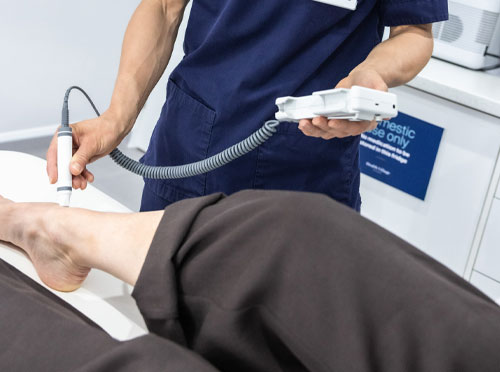
A Doppler assessment at the Gentell clinic, 13 Church Street — the test that comes before any compression.
If you're arranging care for a parent
Three questions for the GP appointment: has an ABPI been done, is a vascular referral appropriate, and who is responsible for the dressing plan? District nursing only covers the genuinely housebound, so "she can still get to the surgery" can mean no visits; care-home residents are entitled to community nursing input through the home's arrangements — home dressing care on this page exists for exactly that gap. Keep a weekly photo of the wound beside a coin for scale and a simple dressing log; national wound-care guidance expects measurable progress, so if four weeks pass without improvement, asking for a reassessment isn't pushiness — it's the guideline.
Whatever route you choose
See your NHS GP first if the wound is new, painful, or you have diabetes — and use the urgent-care signs above. This page signposts services available in Esher; it's general information, not medical advice, and it doesn't diagnose anything. Your NHS GP remains central to your care. Sources: NHS: Venous leg ulcer · NICE CG168 · NICE NG152 · NICE NG19 · NWCSP Leg Ulcer Recommendations.
Finding us at 13 Church Street
Health Village is moments from Esher High Street, with public pay-and-display car parks a short walk away. Download the finding-us map (PDF). The building is a refurbished Victorian property with two flights of stairs — if travel or stairs are hard, home visits are the published answer. Patients come from Esher, Claygate, Cobham, Oxshott, Thames Ditton, Weybridge and Walton-on-Thames.
A consulting room at 13 Church Street.
Common Questions
Questions about Leg Ulcers
Why won't my leg ulcer heal?
More than 60% of leg ulcers are venous: faulty valves let pressure build in the lower leg, holding the wound open, so dressings treat the hole but not the pressure. That's why a leg wound that hasn't healed in two weeks has its own NHS referral pathway — the cause needs assessing, not just the wound.
Can the NHS treat my leg ulcer for free?
Yes — and for most people it should be the first stop. Your GP or practice nurse can refer you; district nurses visit the genuinely housebound; community wound clinics provide trained compression, the standard of care, and most venous ulcers heal within six months with it. These services run on referral, so the GP appointment is the gateway.
What does private leg ulcer care cost in Esher?
Only what's published: UK Vein Care charges £250 for a consultation and scan, with complete vein treatment from £2,495 per their price list. Aespect's wound care is £45 (simple) or £60 (complex) plus dressing supplies. The Gentell Wound Care Clinic quotes in writing on request. Nobody here invents a "typical total".
Do I need to see a vein clinic or a wound clinic?
Honestly — possibly both, in sequence. Assessment first (a Doppler or duplex scan tells you the cause), wound care while it heals, and vein treatment to stop it returning where veins are the cause. No single practice covers the whole pathway, and this page says so.
Do I need a GP referral?
Not for any of the three private routes — all accept self-referral (insurers may ask for a GP letter). The NHS route runs through your GP, and an ulcer open more than two weeks warrants that visit regardless.
Can someone visit my mother at home?
Aespect offers home visits on request, and Gentell's profile lists home and care-home visits by arrangement. NHS district nursing visits people who are genuinely housebound. If you're arranging care for a parent, say at booking that it's a home visit you need.
When is a leg ulcer an emergency?
Same-day GP or NHS 111 for spreading redness or heat, pus, fever, or sudden severe pain; 999 if the foot turns pale, cold and painful. And any new foot ulcer in a person with diabetes needs specialist referral within one working day.
Where is Health Village, and what about stairs?
13 Church Street, Esher KT10 8QS, a few minutes' walk from the High Street with public pay-and-display parking nearby. It's a refurbished Victorian building with two flights of stairs — where that's a barrier, home visits are the published answer.
Not sure which door is yours?
Tell us what's going on — we'll point you to the right practitioner
Your enquiry comes to the Health Village team, not the practices — and it's fine to be asking for a parent. We reply within one working day with a suggestion of where to start, including when the free NHS route is the honest answer. Nothing is passed to a practice without your say-so.
All practitioners at Health Village work independently and are responsible for their own clinical care and treatment outcomes. Information on this page is for educational purposes and does not constitute medical advice. Always consult a qualified practitioner for diagnosis and treatment. Page last reviewed: 1 August 2026. Service details and fees checked against each practice's published information; next check due February 2027 · Health Village Esher