Starting private practice alongside NHS work
You may already know the care you want to offer. The harder part is deciding how a private clinic will fit around your NHS work, what you will take responsibility for and how patients will find you.
Begin with one clinic session. You can then compare premises and support against your own written plan.
In this guide
Health Village publishes this guide and offers space for independent practices on Church Street in Esher. Use the planning questions with any premises provider. Where we describe Health Village, we make that connection clear.
Download the practitioner workbook (PDF, eight pages). Print it and use it to plan your service, session costs and questions for a room visit. Your notes stay with you.
Write down the service you will offer
Describe a first appointment in a few sentences. Name who it is for, the ages you can see and what you will do. Then describe what happens afterwards. An assessment with a report, an ongoing therapy appointment and a procedure need different arrangements.
Give the service a boundary. Decide which enquiries you will decline or redirect, which need a referral and which may require care you cannot provide in that setting. A broad claim on a website can create work your clinic was never designed to handle.
- My first appointment is for: ____________________
- The ages and scope I can accept are: ____________________
- The appointment includes: ____________________
- Reports, tests or follow-up are arranged by: ____________________
- Enquiries outside my scope will go to: ____________________
Keep that description beside you when you compare rooms or brief someone to build a profile. It is the same service in both places.
Set the boundary with your NHS work
Check your employment contract and local arrangements before committing to a clinic pattern. Discuss the work and any required declarations with the appropriate employer contact. Keep a written record of what has been agreed.
For GMC registrants, the conflicts guidance requires openness with employers and patients about relevant interests. Private fees and reasonable alternatives should be explained clearly. Read the guidance for your own role before shaping a referral or promotional arrangement.
Ask your insurance or indemnity provider to confirm cover for the exact private work, patients and settings you propose. NHS employment is not proof that additional private work is covered. Ask what changes you must report as the clinic develops.
Add the administrative work to your diary as well as the clinic. Letters, results and patient messages will still need an owner on the days you are at your NHS job.
Relevant guidance: GMC guidance on conflicts, interests and fees, GMC insurance and indemnity resources.
Check the provider and the business
In England, CQC registration depends on the regulated activities and the legal entity carrying them on. A venue’s address or another practice’s registration does not settle the position for your proposed service. Use CQC’s scope guidance to identify who is responsible.
There are exceptions for some independent medical practitioners, with specific conditions and exclusions. Their applicability can change with the service or people involved. Confirm your position with CQC and your adviser before offering appointments. Include any remote service in that discussion.
Decide how the business will operate and who will contract with patients. GOV.UK explains the different responsibilities of sole traders and limited companies. An accountant can help you assess the structure for your circumstances and the records you will need.
Put the decisions into a short responsibility sheet. Record the clinical provider, the business taking payment, the premises provider and the people responsible for records and complaints. Ask each organisation to confirm its part. Keep unresolved items visible before the first appointment.
Relevant guidance: CQC: who has to register, CQC: medical practitioners in independent practice, GOV.UK: setting up a business.
Plan one clinic session from arrival to follow-up
Work backwards from a real session you could attend. Include setting up, patient appointments, breaks and the time needed to finish records. Leave room for the tasks that happen after the patient has gone.
| Part of the session | Write your arrangement |
|---|---|
| Arrival and preparation | Access time, equipment checks and room setup |
| Patient arrival | Who greets the patient and how the practice knows they have arrived |
| Appointments | Length, gaps and maximum number you can safely offer |
| Records and payment | Who completes each task and where it happens |
| Results and follow-up | Named owner, communication route and protected time |
| Closing the session | Room reset, secure storage and any work to take away |
For HCPC registrants, the standards include informed consent and clear, prompt, secure records. Other professions have their own standards. A shared reception can help with agreed practical tasks. Your practice still needs arrangements that meet the requirements of your role.
Try the plan as a rehearsal before you accept a full diary. Walk the route a patient will take and check how someone reaches the practice when the building is closed.
Relevant guidance: HCPC conduct, performance and ethics standards.
Take your clinic plan on the room visit
A room photograph can help you shortlist premises. A visit lets you test the details that affect your service. Take the appointment plan and ask to see the route your patients will use.
- Which room is suitable for the service, equipment and patient ages I have described?
- How will a patient reach that room, including anyone who needs access support?
- What is supplied, and what must my practice bring, maintain or arrange?
- How are privacy, sound and patient waiting handled?
- What are the arrangements for cleaning, storage and waste relevant to my work?
- Which reception tasks are included and which remain with my practice?
- What session pattern can you currently offer, and how are changes handled?
- What are the complete price, tax treatment, deposit, notice and cancellation terms?
Ask for the agreed answers in writing. Compare providers against those answers and your appointment plan. A feature matters when you can explain how your clinic will use it.
If Esher fits your patients and working week, explore the Health Village rooms and arrange a visit. Reception will need to confirm current suitability, availability and terms for your proposed service.
Work out the cost of a session
Use the amount you expect to collect for a completed appointment. Deduct the costs that arise each time you see a patient. Then compare what remains with the session’s fixed costs and the amount you need to earn for your work.
Include costs that are easy to overlook: reports written outside the appointment, administration, payment fees, software and the appropriate allocation of insurance or professional costs. Ask your accountant how to treat tax and costs for your business. Keep a cash buffer for quieter sessions and delayed payments.
| Your input | Your amount |
|---|---|
| Fee actually collected per completed appointment | £ ______ |
| Direct cost per completed appointment | £ ______ |
| Contribution per completed appointment: fee minus direct cost | £ ______ |
| Fixed cost allocated to this session | £ ______ |
| Planned earnings for your work, before tax | £ ______ |
| Maximum appointments your session can safely hold | ______ |
Divide the fixed cost plus your planned earnings by the contribution per completed appointment. Round up to a whole appointment. If the contribution is zero or negative, the model needs changing before this calculation is useful.
For illustration only, imagine a £120 collected fee, £20 direct cost and £240 fixed session cost. Each completed appointment contributes £100. Three appointments cover that fixed cost. If the clinician also plans £300 in earnings before tax, the session needs six completed appointments. These are invented planning figures, not Health Village prices or a forecast of bookings.
Compare that answer with your actual capacity and the enquiries you can substantiate. Repeat it with fewer completed appointments. Include your policy for cancellations and non-attendance, rather than assuming every available slot will produce income.
Relevant guidance: GOV.UK: setting up a business.
Make the appointment easy to understand
Before commissioning a campaign, give a patient enough information to decide whether to enquire. Your profile and appointment page should describe the same service you put into the clinic plan.
- Who the appointment is for, including any age limits or referral requirements
- The practitioner and the qualifications you have approved for publication
- What the appointment covers and what is arranged separately
- The current fee or a clear way to obtain a complete quotation
- Who handles booking, reports and follow-up
- How to contact the practice and what to do outside its service scope
For GMC registrants, explain charges before investigation or treatment and help patients understand additional costs. Give useful information about reasonable alternative care, including an NHS option where relevant. Avoid claims about waiting times you cannot substantiate.
Link each description to a useful destination. Someone reading about an assessment needs the assessment details. Someone planning a first visit needs practical information. Clear link text helps the reader understand what they will find next.
Check health promotion against the relevant rules before it appears on a website or social account. CAP prohibits advertising prescription-only medicines to the public, including indirect promotion. Have claims and medicine-related wording checked for the actual proposed material.
At Health Village, you can use the practitioner directory to see how profiles are presented and the patient booking and fees guide to see the questions patients are encouraged to ask.
Relevant guidance: GMC guidance on conflicts, interests and fees, Google guidance on useful link text, ASA/CAP guidance on prescription-only medicine promotion.
Give every enquiry a clear next action
Write down who handles a new enquiry and how it reaches the practice. Agree the information needed to establish whether the service is appropriate. Clinical assessment and advice belong with the appropriately qualified person.
Keep the stages distinct in your records. An enquiry received, an enquiry suitable for your service, an appointment booked and an appointment attended tell you different things. A website button click does not establish any of them.
- Who checks the enquiry and how will they contact the patient?
- How will the practice recognise an enquiry it cannot accept?
- What booking or payment action follows once suitability is established?
- Who checks that the enquiry reached the right person?
- What happens to messages received when the practice is closed?
We send you patients. At Health Village, that means reception receives patient enquiries and routes them to the relevant independent practice. The practice checks suitability and makes its own booking and care arrangements. Discuss how that handoff will work for your service before counting prospective enquiries in a business plan.
If you buy marketing support, agree its scope separately. Specify the work, the price, the reporting and who owns the accounts and material. Ask how a reported result connects to the patients your practice can actually see.
Keep clinical information with its proper owner
Decide which information reception needs for a practical handoff and which belongs in the practice’s clinical system. Document the responsibilities of each organisation and the systems used. Keep the patient’s clinical record and any practitioner marketing activity separate.
Health information can be special category data. ICO guidance explains the need for a lawful basis and an additional condition for processing it. Work through the guidance for your actual activity and obtain advice where needed. Check the ICO’s current updates as its guidance develops.
Use the ICO fee checker to establish whether your business must pay the data protection fee. Keep the result with your setup records. A room agreement does not answer that question for you.
- Which organisation is responsible for each record or enquiry?
- What privacy information will the patient receive?
- Who can access records and how is that access managed?
- How will reports, requests and complaints reach the practice?
- What happens to records and contact details if the practice changes premises?
At Health Village, patient care enquiries are kept out of the practitioner marketing system. Agree your own clinical and administrative arrangements with the relevant people before the first appointment.
Relevant guidance: ICO rules on special category data, ICO data protection fee checker, HCPC conduct, performance and ethics standards.
Review the first session before adding more
After the first clinic, compare what happened with the plan. Record the work that continued after the session and the enquiries that were unsuitable. A fuller diary is useful when you can deliver the follow-up as well as the appointments.
- Appointments booked and completed, with the source of each enquiry where known
- Money collected, direct costs and time spent outside the clinic
- Questions patients repeatedly asked before booking
- Delays or handoffs that need a named owner
- Changes needed to the service page, booking process or room arrangement
Choose a review date and one change to make first. A fee explanation, an enquiry handoff or a room setup may be more useful than another campaign. Check the effect before you add a new session or buy more promotion.
Bring your plan to Health Village
If you are considering a practice in Esher, bring your clinic plan and questions to a room visit on Church Street. Describe the service, the session pattern and anything the room must support.
Start with Practise here to arrange a visit. You can compare the space with your own requirements before deciding on a room arrangement. Any separate marketing work needs its own agreed scope and price.
Practical questions
Can I start private work while I am employed by the NHS?
Check your employment contract, local arrangements and professional requirements for the work you propose. Discuss relevant declarations with your employer and get confirmation from your insurance or indemnity provider before committing to appointments.
Relevant guidance: GMC guidance on conflicts, interests and fees, GMC insurance and indemnity resources.
Does renting a consulting room settle CQC registration?
CQC considers the regulated activity and the legal entity responsible for it in England. Check your proposed service and any applicable exception using its guidance. Confirm the position before you offer appointments.
Relevant guidance: CQC: who has to register, CQC: medical practitioners in independent practice.
How do I decide how many appointments a session needs?
Use your collected fee, direct appointment costs, fixed session costs and planned earnings. Compare the required completed appointments with the capacity you can safely offer. Include quieter sessions and non-attendance in your planning.
What does Health Village mean by sending patients?
Reception routes patient enquiries to the relevant independent practice. That practice checks suitability and arranges bookings and clinical care. Ask how the handoff works for your service. Base your plan on enquiry numbers you have evidence for.
What should I bring to a room visit?
Bring a description of the service, the session pattern you want and the equipment or access arrangements it needs. Take your cost worksheet and ask the provider to confirm the complete terms in writing.
Do I need a marketing package before I can start planning?
Start with a service you can describe and a clinic you can run. Establish suitable premises, clear appointment information and an enquiry process. If you consider marketing support, compare the proposed work and reporting with the gaps in that plan.
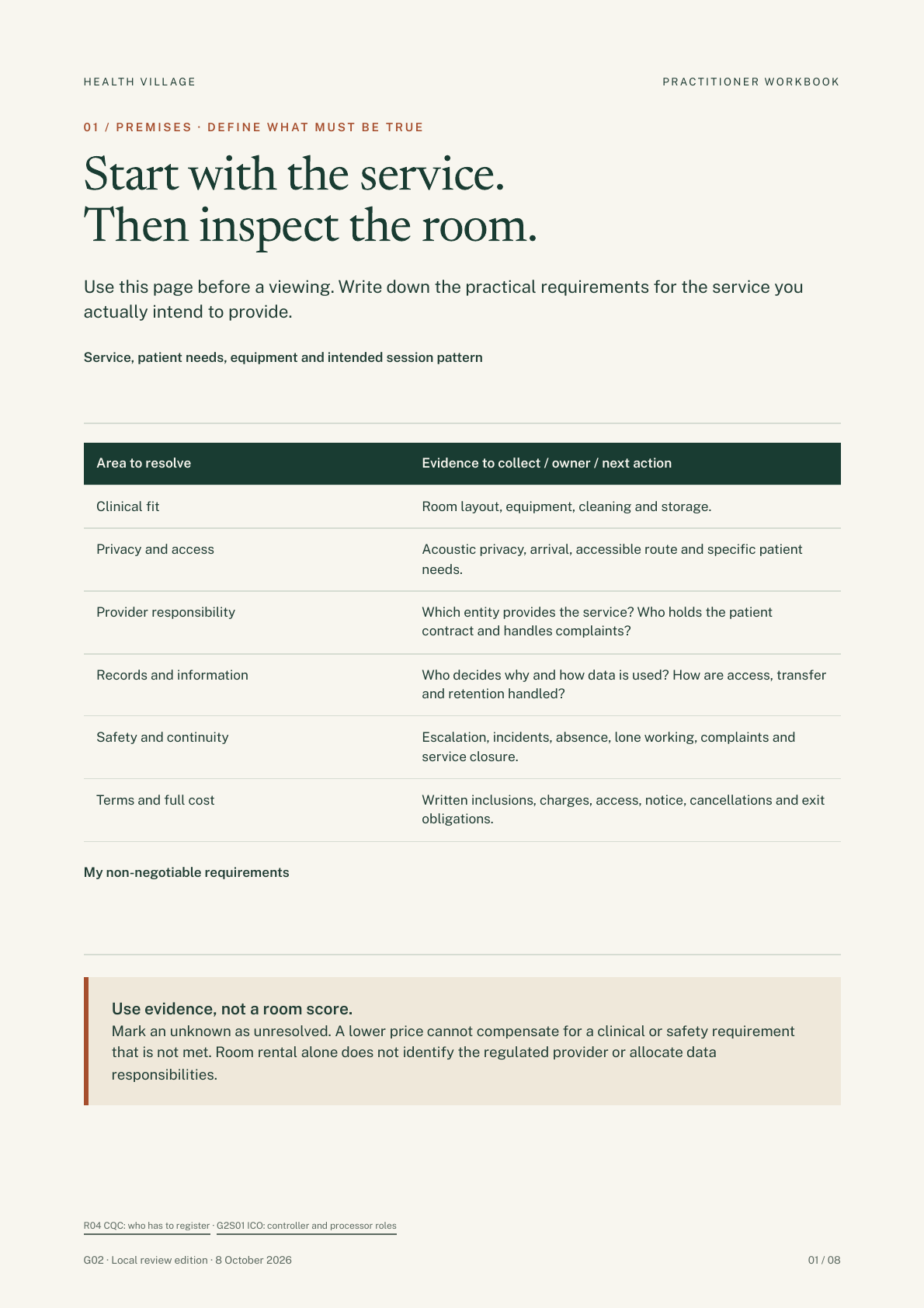
PRACTICAL WORKBOOK · 8 PAGES · FREE
Put your clinic plan on paper before you cost it.
Make space for room-fit evidence, your working session and the information a prospective patient needs. Use your own figures and professional requirements.
- Check the evidence you need from a consulting room.
- Connect session costs with your working time.
- Make your service and next step easier to understand.
PRACTITIONER GUIDE · 20 PAGES · FREE
NHS and private practice.
Your next step can be a small one. You do not need a complete business before you can make a useful decision.